Code that stands the test of change
September 19, 2026 · Updated September 19, 2026
Knowing the difference between design patterns and architecture is what separates a developer from a tech leader building sustainable systems.

In technical meetings we get lost in the latest framework and forget that code rots from the inside when it has no structure. It is shiny-object syndrome: we argue about the cloud and microservices while the business keeps running on foundations nobody has looked at in years.
The engine and the gears
The difference between architecture and patterns is a matter of scale. Architecture is high-level design: it decides if the system is a family SUV or an electric sports car and defines the engine placement for stability. These are the decisions that are hard to change once the team starts working.
Design patterns are the proven gears inside, like the brakes or the differential. We don't reinvent the wheel for every subsystem: we use conceptual templates so classes and objects talk to each other without getting stuck.
Seniority is measured in flexibility
A junior developer codes for today's response, but a senior designs for tomorrow's change. Mastering patterns prevents a simple module update from breaking unexpected parts of the application.
I've seen hours of technical debate solved with a single sentence: let's use an Adapter pattern here. Speaking a common language saves time and stops over-engineering, because a real expert knows when to skip a pattern to keep the product simple.
Models to scale the business
Every leader should know how to organize code. Hexagonal architecture isolates business rules from the database, clean architecture arranges that same idea in layers where the inner ones know nothing about the outer ones, and event-driven architecture lets components react to messages without knowing each other.
Underneath all of them sits domain-driven design. Before deciding on layers you have to name what the business actually does, draw its boundaries and speak the same language as the people running it. Without that the layers come out spotless and organize a domain nobody understood, which is the most expensive way to be right.
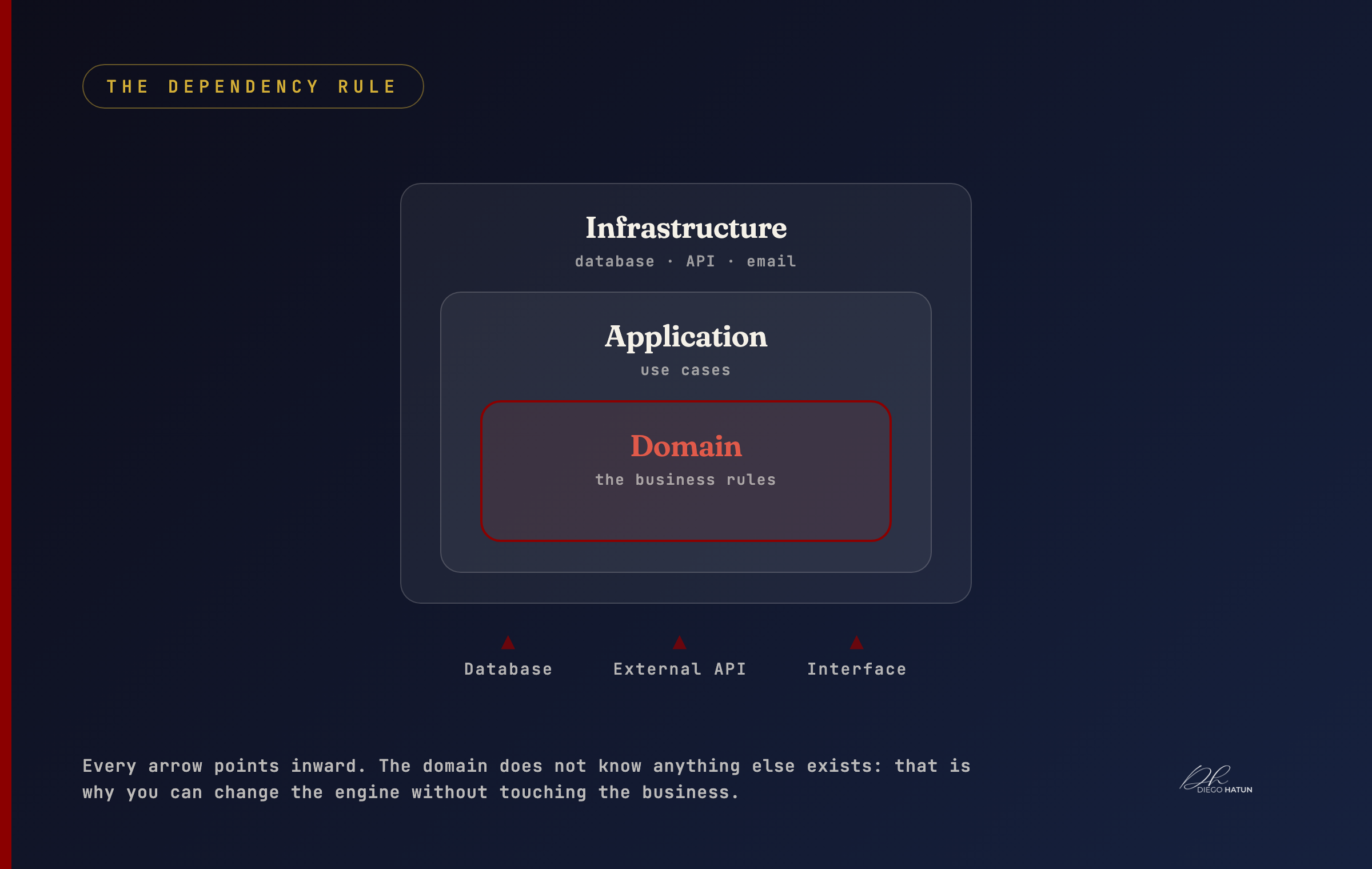
The synergy is clear: architecture defines the rules for independence and design patterns deliver the concrete code to enforce them.
And very often the right answer is the boring one. A well-modulated monolith, with clear boundaries inside it, holds up an entire business for years and deploys with a single command. The hybrid is legitimate too: the monolith at the center and a couple of services outside it, only where load or rate of change earn it. I have seen five-person teams split a system into eight services and spend the next year fighting the network instead of the business. Architecture has to earn the cost it imposes.
| Option | Cost | Risk | Verdict |
|---|---|---|---|
| Modular Monolith | CostLow, and low to operate | RiskCouples up if nobody guards the boundaries | VerdictThe default until something hurts |
| Hexagonal Architecture | CostMedium initial dev cost | RiskLow risk with vendor changes | VerdictIdeal for complex business domains |
| Clean Architecture | CostMedium layer-discipline cost | RiskExtra layers if the domain is simple | VerdictGood when the team rotates and the domain lasts |
| Composable Architectures (MACH) | CostHigh service integration cost | RiskExternal connectivity risk | VerdictRecommended for cloud-native ecosystems |
| Event-Driven Architecture | CostMedium broker cost | RiskComplexity in traceability | VerdictWinner for systems needing absolute scalability |
A roadmap for the team
To master micro-design, I recommend the Refactoring Guru catalog: the same twenty-three as always, grouped into creational, structural and behavioral, each one with its example and its code beside it. The team should adopt SOLID principles before picking the latest framework, because infrastructure must serve the domain and not the other way around.
That catalog solves design inside a single process, and almost no system lives inside just one any more. Once the code starts talking over the network, others show up. The circuit breaker cuts the call to a service that is down instead of waiting for the timeout to drag everyone else with it. CQS separates reads from writes, and CQRS carries that separation all the way to storage. Vertical slices organize code by whole feature instead of by horizontal layers. None of them is mandatory and all of them cost: the question is always which one hurts least.
With this knowledge ready, are we using patterns to build systems that embrace change, or are we creating technical monuments that nobody dares to touch for fear of everything falling apart?